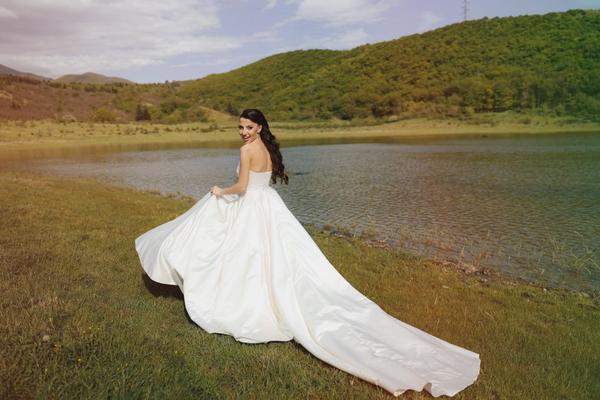
A wedding dress train is beautiful in a photograph, but its real test comes when you turn a corner, cross grass or try to dance. The fabric trailing behind your gown influences how formal the dress feels and how easily you move. Understanding wedding dress train types helps you choose a gown that suits your ceremony and the celebration afterward.
The familiar names—sweep, court, chapel, cathedral and royal—describe increasingly dramatic bridal train lengths. They are useful shopping terms, not universal measurements. Designers may measure from the waist or the back hem, so compare actual dresses rather than trusting a label alone.
Wedding Dress Train Types, From Shortest to Longest
Sweep or Brush Train: A Subtle Finish
A sweep train barely extends beyond the back hem, often by just a few inches and generally less than a foot. It gives a slip dress, fitted crepe gown or relaxed A-line shape a soft trailing edge without a large pool of fabric. For a garden ceremony, restaurant wedding or beach celebration, that restraint can be an advantage.
It is usually easier to manage than longer designs, although ground-level fabric can collect dirt. Many sweep trains need no bustle. Try taking a backward step during your fitting, since even a short extension can catch under a heel.
Court Train: Noticeable but Manageable
A court train falls slightly farther behind than a sweep train, commonly around one to two-and-a-half feet, depending on the designer’s measuring method. It gives guests a clearer view of trailing fabric as you enter while remaining practical in compact spaces.
Think of a civil ceremony followed by dinner in a historic townhouse. A court train adds occasion without demanding constant rearranging between rooms. Shape and fabric matter: a narrow, heavy train may feel less manageable than a broader one made from light tulle.
Chapel Train: Classic Bridal Drama
A chapel train wedding dress is a compromise between visual impact and wearability. Bridal retailers commonly describe chapel trains as extending roughly three to four-and-a-half feet behind the wearer, although measuring conventions vary. There is enough fabric for an elegant aisle photograph, without the sweeping scale of a cathedral design.
This length works in churches, hotels and indoor venues with moderate aisle space. Arrange the train for portraits, then lift it with a professionally fitted bustle for dinner and dancing. When comparing different wedding dress silhouettes, notice how the same chapel-length train looks fuller on a ball gown than on a sheath.
Semi-Cathedral and Cathedral Trains: A Grand Entrance
Some designers offer a semi-cathedral length between chapel and cathedral. A cathedral train wedding dress is more dramatic: one bridal retailer describes cathedral trains at approximately six to seven-and-a-half feet behind the bride. The fabric creates a formal line in a spacious church or ballroom.
That grandeur requires planning. Ask whether the venue has a narrow aisle, steps, outdoor paths or rough flooring. An attendant may need to straighten the train before you walk and arrange it for photographs. A secure bustle or detachable option makes the reception easier.
Royal or Monarch Train: Maximum Ceremony Impact
Royal, sometimes called monarch, trains may extend ten feet or more and are intended for an exceptionally formal effect. They suit generous floor space and a ceremonial entrance better than crowded reception rooms.
Long trains can be heavy, especially when embroidered or beaded. Before ordering one, establish who will carry or position it, where it can be spread safely and how it will be managed after the vows. The most impressive train is one you can enjoy wearing.
Train Shape Matters as Much as Length
Not every train grows from the skirt. A Watteau train falls from the shoulders or upper back, creating a cape-like line over a simpler gown. Detachable overskirts and removable train panels offer a similar change of mood: dramatic for the ceremony, lighter afterward.
Fabric changes the experience. Tulle can spread widely while remaining light; structured satin holds a defined outline; lace adds texture but may snag on uneven surfaces. When browsing wedding dress fabrics, ask to see the back of each gown in motion, not only posed on a platform.
Match the Train to Your Venue and Schedule
Instead of choosing length solely by formality, map the route you will take. A cathedral-length train might look perfect along a smooth aisle yet become awkward during a garden cocktail hour. A sweep may be more comfortable for a destination wedding with stone walkways, sand or frequent location changes.
Imagine a bride marrying in a cathedral but holding her reception in a small restaurant. A detachable cathedral train over a simpler gown could deliver the grand entrance she wants without dragging fabric between tightly packed tables. The question is not just where the ceremony happens, but what the dress must do afterward.
What to Test Before You Commit
At your appointment, wear shoes close to your intended heel height. Walk, turn, sit, climb a step and let someone arrange the train behind you. Ask the consultant to demonstrate the proposed bustle, including how long it takes to fasten and whether the weight pulls at its attachment points.
A bustle lifts and secures the train, but its success depends on the dress’s construction and professional alterations. Build bustle work into your fitting plan rather than assuming it comes with the gown. Review wedding dress alterations before committing to a longer train.
Frequently Asked Questions
What is the easiest wedding dress train to walk in?
A sweep train is generally the simplest traditional option because it leaves little extra fabric behind you. A dress without a train offers even more freedom. Still, fabric weight, skirt width and shoe choice can change how easy any gown feels.
What is the difference between a chapel and cathedral train?
A chapel train produces a moderate trailing effect suited to many ceremony spaces. A cathedral train extends substantially farther and creates a grander, more formal silhouette. Exact lengths differ between designers, so ask to see both styles spread out during a fitting.
Does every wedding dress train need a bustle?
No. A short sweep may be manageable without one, while many chapel and longer trains benefit from a bustle during the reception. Detachable trains offer another solution. Your alterations specialist can advise on the most secure arrangement for your gown.
Can a long train work at an outdoor wedding?
Yes, but inspect the route first. Grass, gravel, sand, moisture and uneven paving can catch or soil trailing fabric. Consider a protected walkway, help carrying the train between photographs, or a removable design if outdoor surroundings matter more than uninterrupted wear.
Choose the Length That Fits the Whole Day
The best train balances the entrance you imagine with the movement your celebration requires. Sweep and court styles keep things simple, chapel trains offer traditional elegance, and cathedral or royal lengths create a formal statement. Try the gown in motion, discuss alterations early and choose the train that makes you feel confident from the aisle to the final dance.