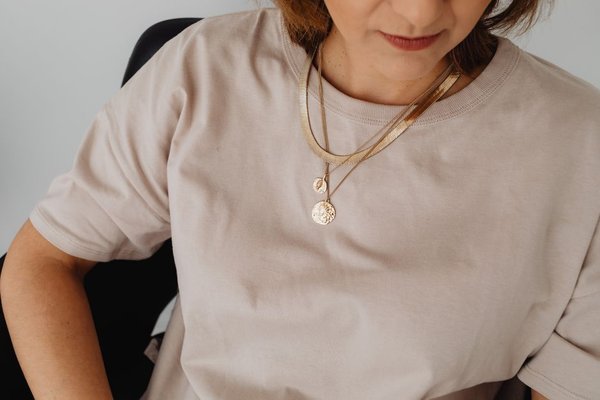
A layered necklace look should feel effortless, but the difference between polished and tangled often comes down to a few centimeters. Two chains that sit almost on top of each other can twist into a knot by lunchtime; three pieces with clearly different roles can look considered all day. If you are wondering how to layer necklaces, start with spacing, movement, and the neckline of your outfit rather than adding every chain you like.
Choose one focal piece, give the other necklaces room to sit around it, and check how everything behaves when you move. These necklace layering tips work with delicate everyday jewelry, chunkier styles, and mixed-metal collections.
Start With a Simple Two- or Three-Necklace Stack
Before attempting a dramatic necklace stack, build one with two pieces. Choose a shorter, simple chain and a longer necklace with a small pendant. The shorter piece frames your neck; the pendant creates a clear stopping point for the eye. If those sit comfortably, add a third necklace with a different texture or length.
Think of the layers as having jobs: a close-fitting base, an optional middle layer, and a focal point. Not every outfit needs all three. A patterned shirt or embellished neckline may look better with just two.
Choose Layered Necklace Lengths That Leave Space
Length gives layered jewelry structure. Common necklace lengths include 14–16 inches for shorter styles, 18 inches for a mid-length chain, and 20–22 inches for a longer layer. These are starting points, not rules: where each necklace falls depends on your neck, torso, pendant, and clothes.
Try the Necklace-on-the-Body Test
Put each necklace on separately, then together. Look for a visible gap between chains and check that pendants do not overlap. A difference of roughly two inches can help, although larger pendants may need more clearance. Adjustable extenders let you refine spacing without buying another necklace.
For example, try a 16-inch chain with a subtle detail, an 18-inch textured chain, and a 22-inch pendant. If that pendant disappears beneath your neckline, shorten it or skip that piece. The goal is to see each layer, not hit exact measurements.
Mix Chain Weights and Textures With Intention
Several ultra-fine chains can cling together because they are lightweight and move similarly. Pair a fine cable chain with a slightly heavier curb, rope, or paperclip style instead. Contrasting textures separate the layers visually and give each piece its own character.
Keep one statement element and let the others support it. If you wear a chunky gold chain close to the neck, balance it with a slim pendant below rather than another oversized chain at nearly the same height.
Be Careful With Very Different Weights
A heavy pendant on a delicate chain may tug downward and swing more than the other necklaces. Choose a chain designed to support the pendant, and check that clasps close securely. A comfortable stack should not feel as though the pieces are pulling against each other.
Make Pendant Layering Look Balanced
Pendants attract attention, so decide which one is the main feature. A coin, initial, gemstone, or sculptural charm can anchor the look. Smaller charms work well above, while one larger pendant often looks best toward the bottom.
Avoid placing two similarly sized pendants at almost the same height. They can collide and create a crowded center. For a relaxed shape, combine a plain short chain, a modest middle charm, and a longer single pendant.
Meaningful pieces need not stay in the jewelry box. Adjust their chain lengths or make your sentimental pendant the focal point so its details remain visible.
Match the Necklace Stack to Your Neckline
Your clothes change how the same necklaces look. A V-neck naturally directs attention toward a pendant following the opening. A crew neck provides a clean background for chains sitting above the fabric. With a button-down, a short chain can show at the collar while a pendant rests inside the open neckline.
With a turtleneck, a medium or long necklace over the fabric usually shows more clearly than a choker. A square neckline already has strong geometry, so a restrained chain and one pendant often feel balanced.
Test the outfit in a mirror, then turn sideways and sit down. If a pendant disappears under a collar or catches on buttons, adjust it. Choosing necklace lengths for different necklines is a useful companion guide when building a versatile collection.
How to Keep Layered Necklaces From Tangling
No combination is completely tangle-proof, especially during a busy day, but a few habits make a noticeable difference.
Separate the Layers Before Fastening Them
Lay necklaces flat in wearing order. Fasten the shortest first, then add longer pieces. Smooth each chain so it sits naturally rather than crossing at the back of your neck. Check that pendants face forward and clasps are closed.
Give Similar Chains More Distance
Two fine chains of the same length tend to overlap. Add an extender to one or replace it with a different link style. If the necklaces repeatedly knot, simplifying the stack may work better than constantly untwisting it.
Consider a Layering Clasp
A multi-strand spacer or layering clasp can hold necklace ends in organized positions. It may reduce spinning and simplify fastening, although it will not prevent all tangling at the front. Check compatibility with your chains and clasps before buying.
Remove each piece separately and store chains fastened and apart. How to organize delicate jewelry without knots is another useful topic if tangled storage is a recurring problem.
Small Styling Adjustments That Make a Big Difference
Mixed metals can look cohesive when pieces share delicate proportions or a repeated shape. Pairing a silver chain with a gold pendant is not automatically a mistake. What matters is whether the layers compete for attention.
Try a simple edit before leaving: remove one necklace and compare the result. If the outfit looks clearer, leave it off. This is especially helpful when earrings, prints, or buttons already provide detail. Jewelry styling for everyday outfits can help you coordinate the rest of the look.
Frequently Asked Questions
How many necklaces should you layer at once?
Two or three necklaces are a practical starting point, offering variety without crowding the neckline. More can work when lengths, pendants, and textures remain distinct.
Can you layer necklaces that are the same length?
Yes, but they may overlap and tangle easily. For a clustered effect, choose contrasting textures or use an extender to introduce a small height difference.
Do mixed-metal necklaces look good together?
Yes. Mixing silver- and gold-tone pieces can look intentional when you repeat one metal elsewhere or keep the shapes and weights compatible.
Why do my layered necklaces keep twisting?
Similar lengths, lightweight chains, moving pendants, and daily motion can contribute. Try more spacing, contrasting chain styles, or a compatible layering clasp.
Build a Stack You Can Actually Wear
Learning how to layer necklaces is less about matching sets than understanding what each piece adds. Space the chains, choose a focal pendant, and match the arrangement to your neckline. Make adjustments based on how the jewelry moves, not just how it looks in a still photograph.